
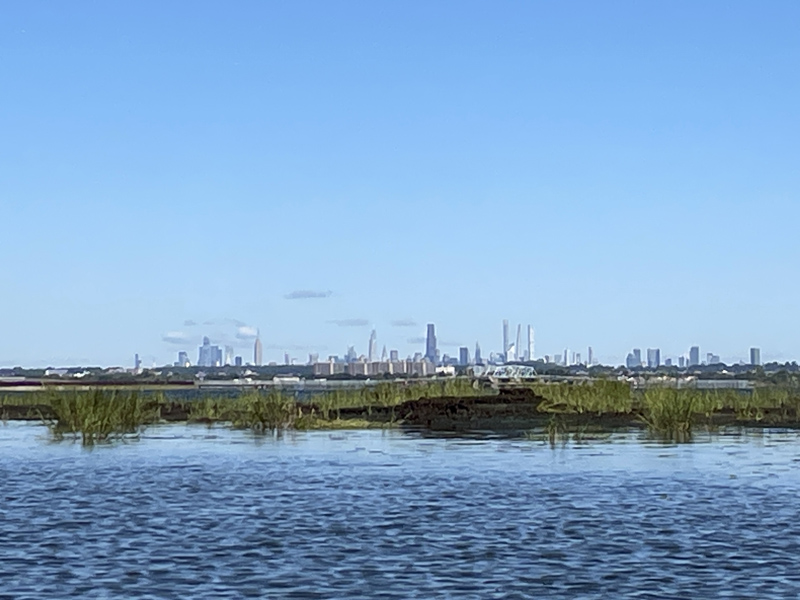
Big Egg Marsh with Fabienne Lasserre and Christy Gast

August 30, 2025

“Have you ever been to Egg Island in Jamaica Bay?” Christy asked in July, “It’s a real cordgrass peatland, right in New York City!” Christy studied and made work about the subject for years with the art and research collective Ensayos, and is working on an upcoming project with a group of collaborators at Mass MoCA.
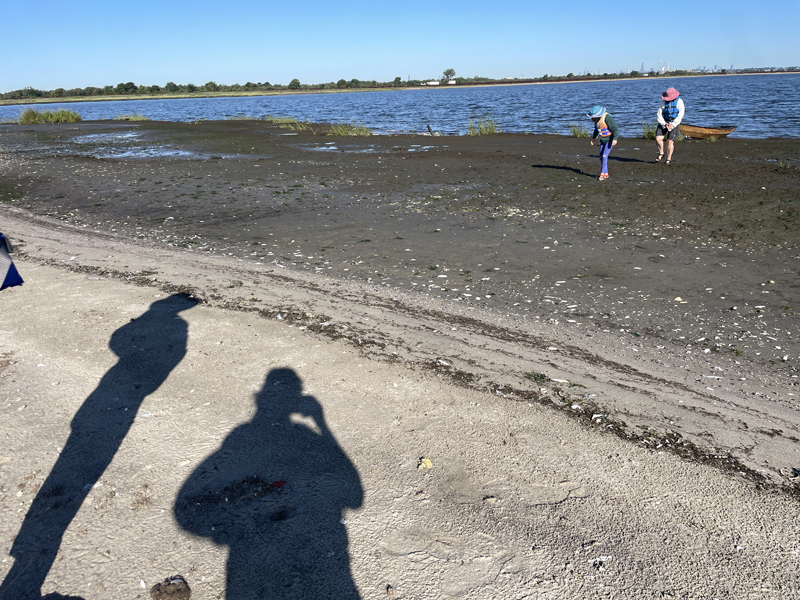
On the way there, Christy told us about how peat is formed in the salt marsh: layers of cordgrass grow and die, accumulating over centuries into dense organic layers that store large amounts of carbon.
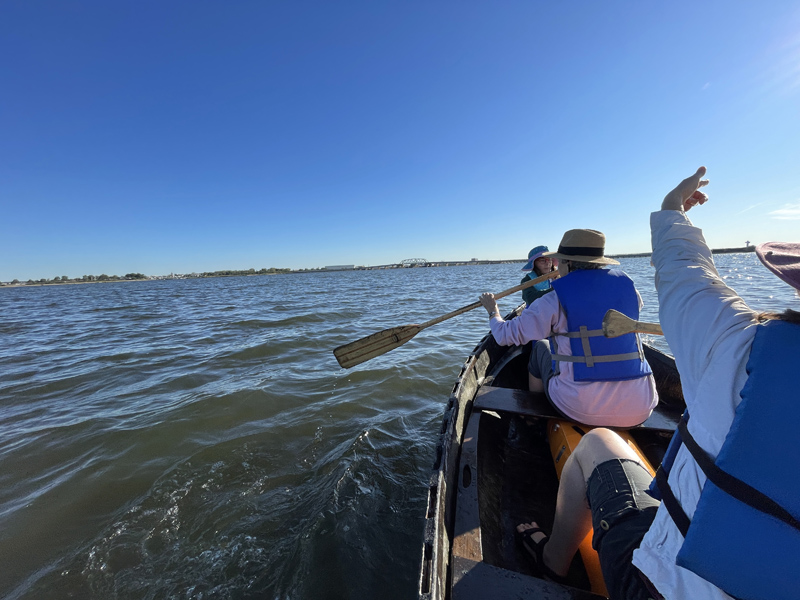
Fabienne Lasserre and her daughter also came along. All three are experts in this kind of adventure; always in good spirits, and they never wonder what to do next.
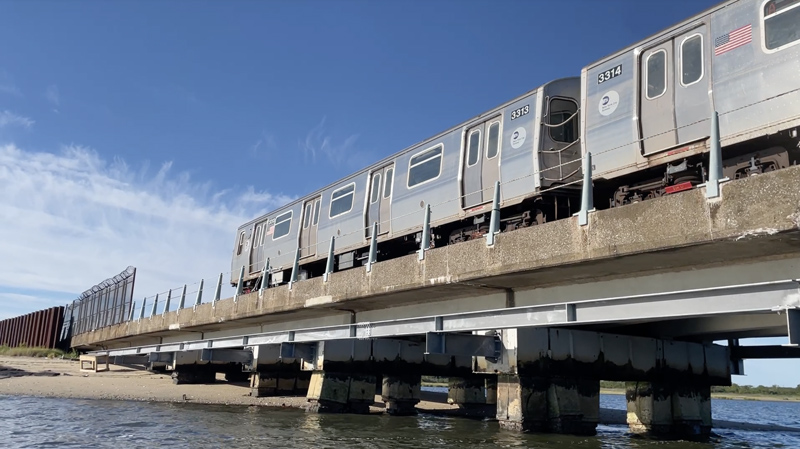
“This is Breakfast Island,” I said.
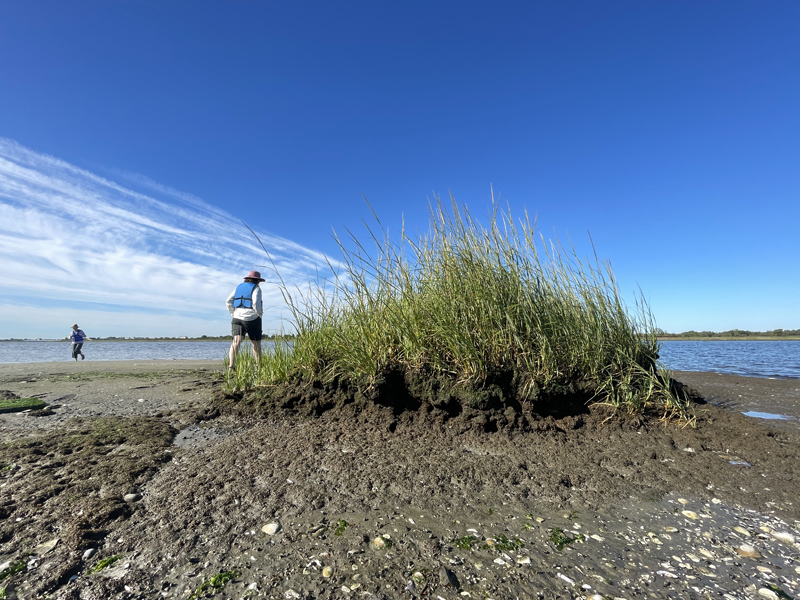
Actually, it was Broad Creek Marsh.
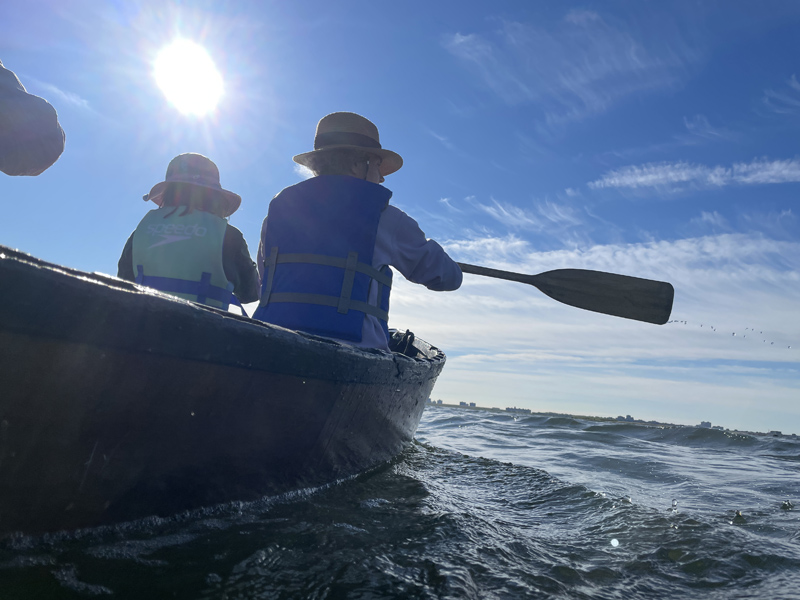
“Lunch Island is straight ahead, that’s where the peat marsh will be.”
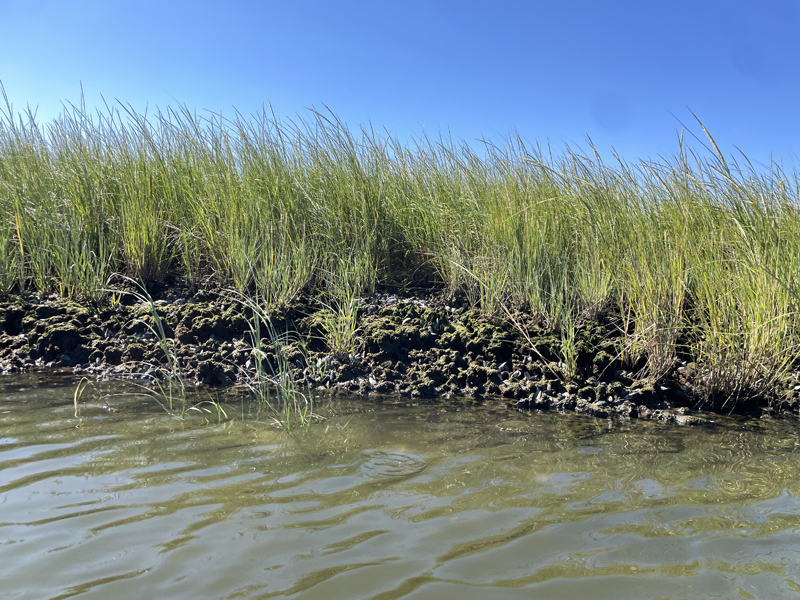
Something different was definitely going on at Lunch Island.
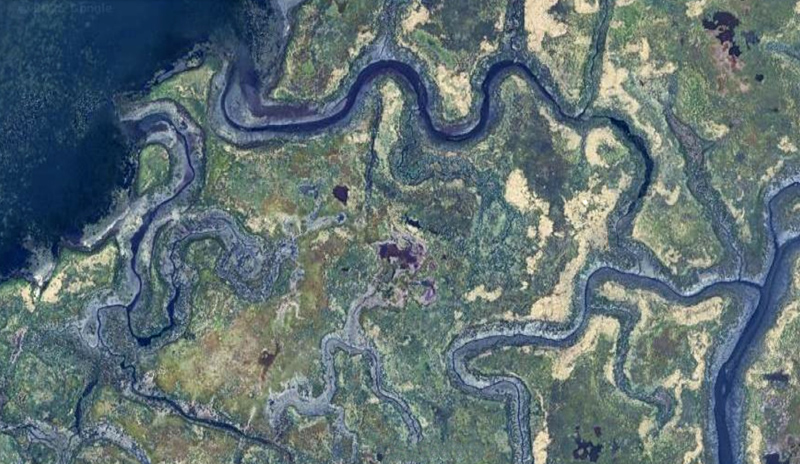
From the satellite image, you can see a network of marsh creeks. “Cordgrass marshes slow storm surge and filter the water,” said Christy.
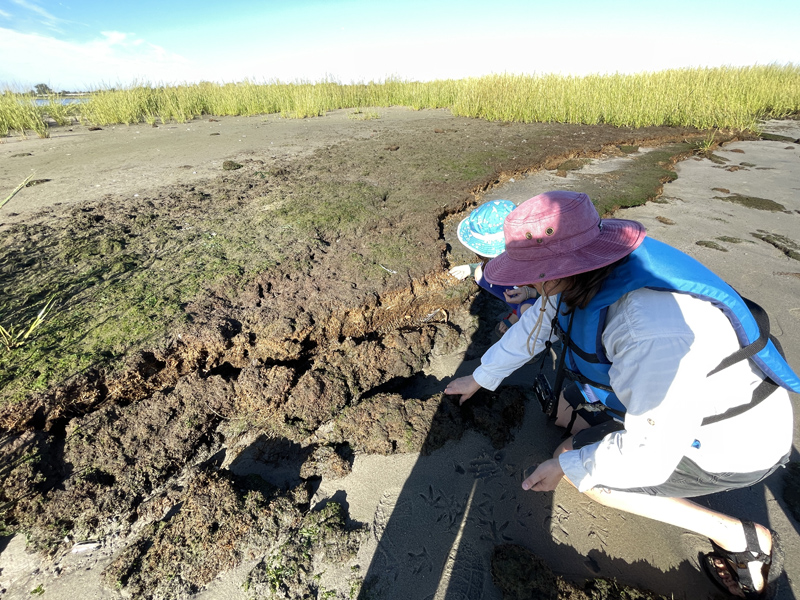
We spotted the “facilitation cascade” immediately: mussels, cordgrass, and the holes of fiddler crabs, just like Christy described on our way over.
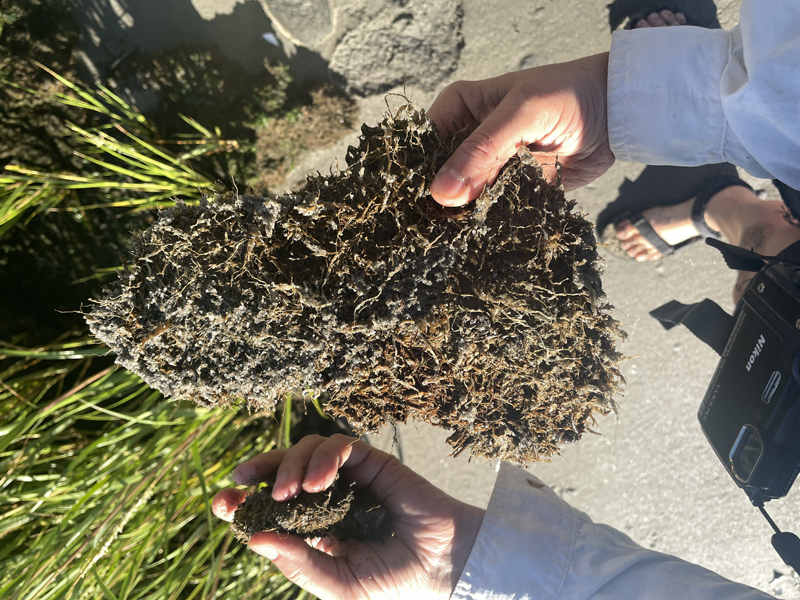
“Peat is great at holding carbon in the ground,” Christy told us. “And it holds the water like a sponge.”
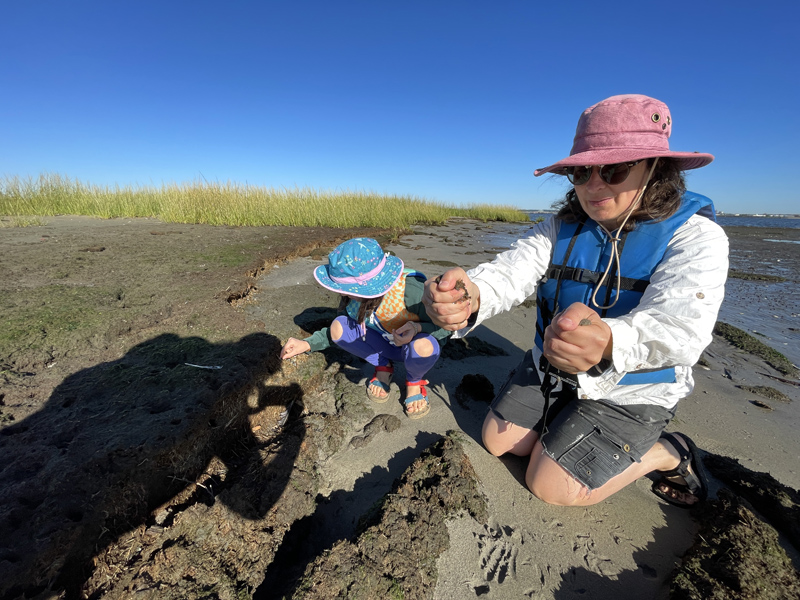
We squeezed the peat, and water poured out as promised.
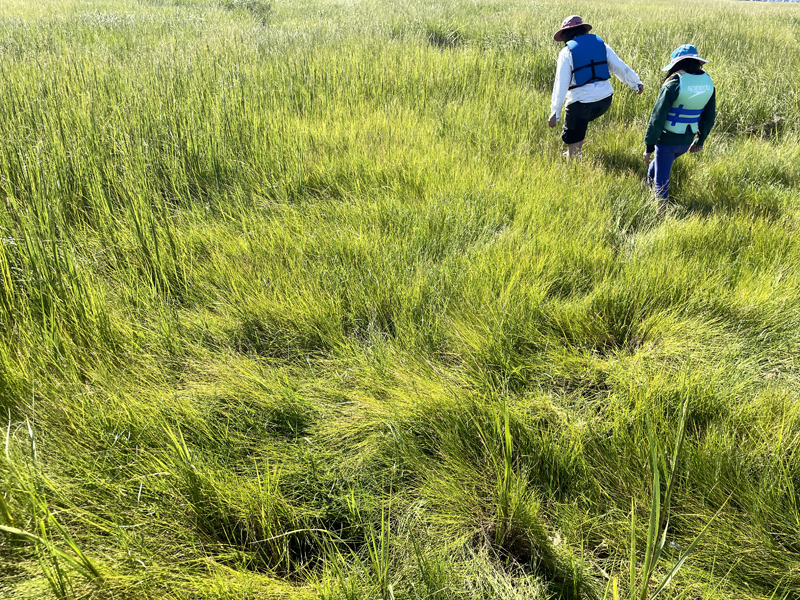
On top of the marsh, the grass had changed.
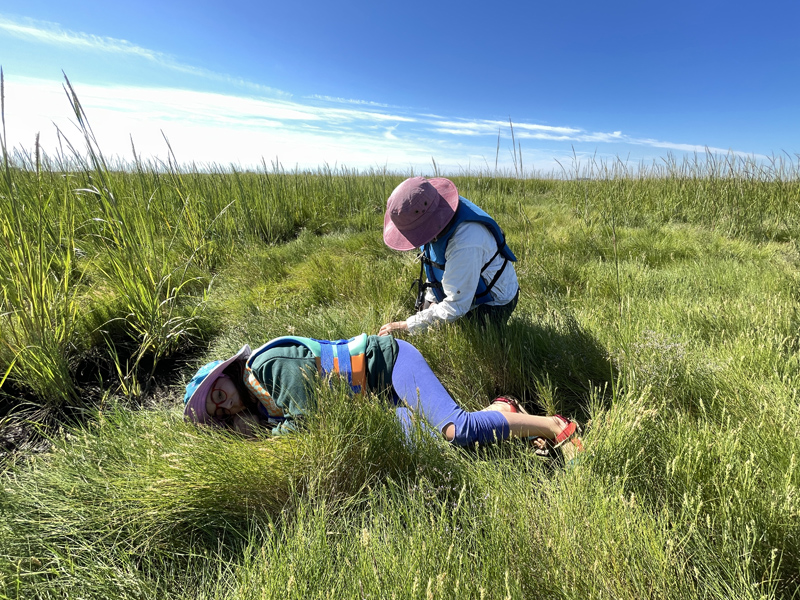
“Perfect for a nap,” said Lou.
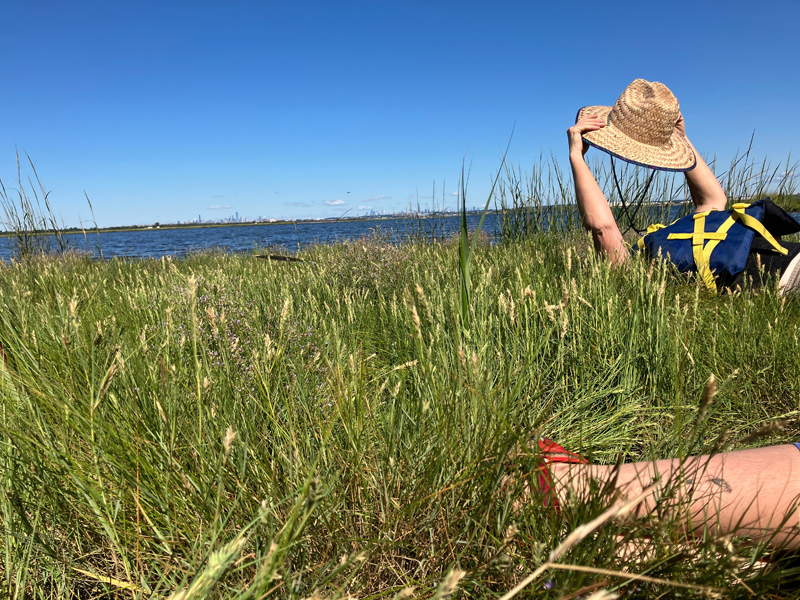
The best Tide and Current adventurers are always like this,
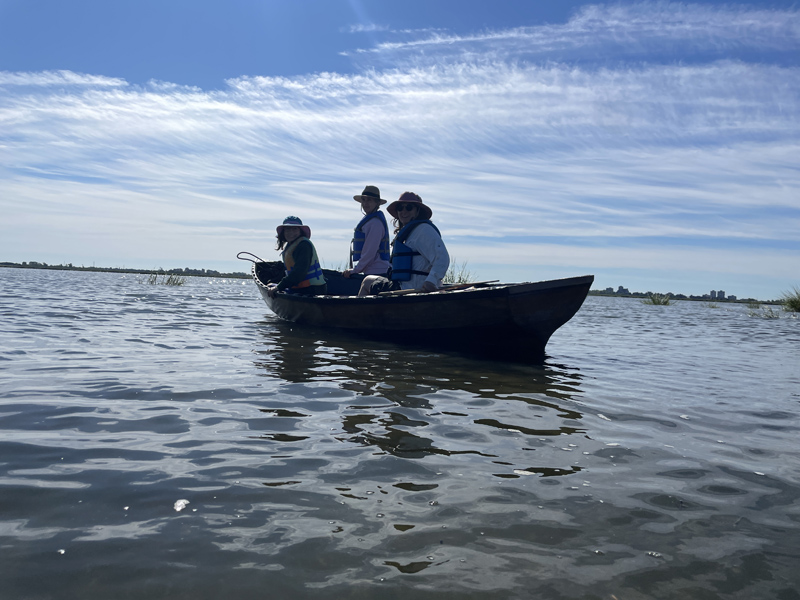
perfectly content with going slow.
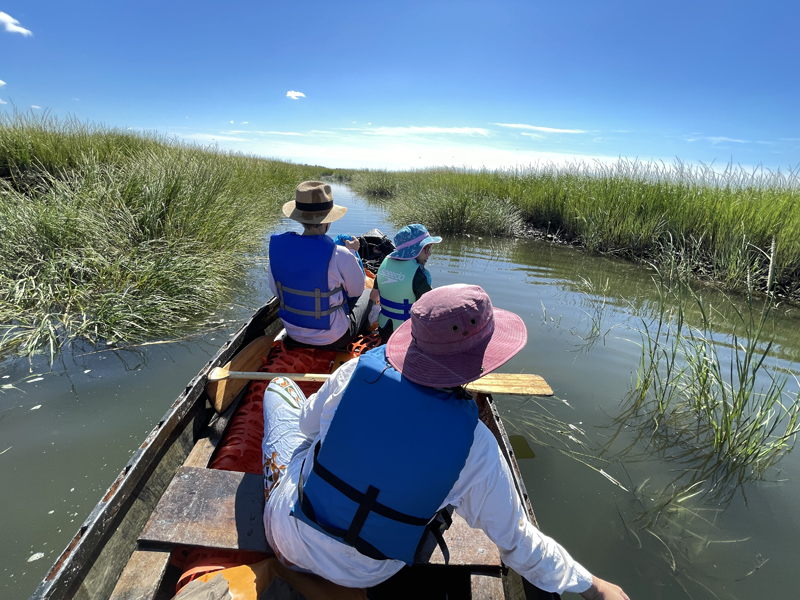
We paddled deep into the marsh creeks, turn after turn, narrower and narrower, terrapins visible on the bottom.
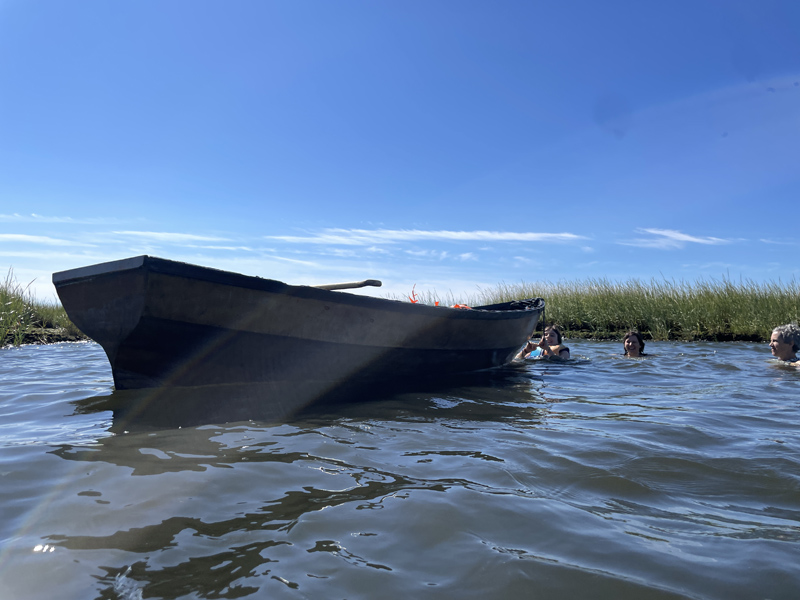
I couldn’t believe how different this healthy marsh felt; the water was clear, the air smelled salty and clean, and there were animals everywhere.
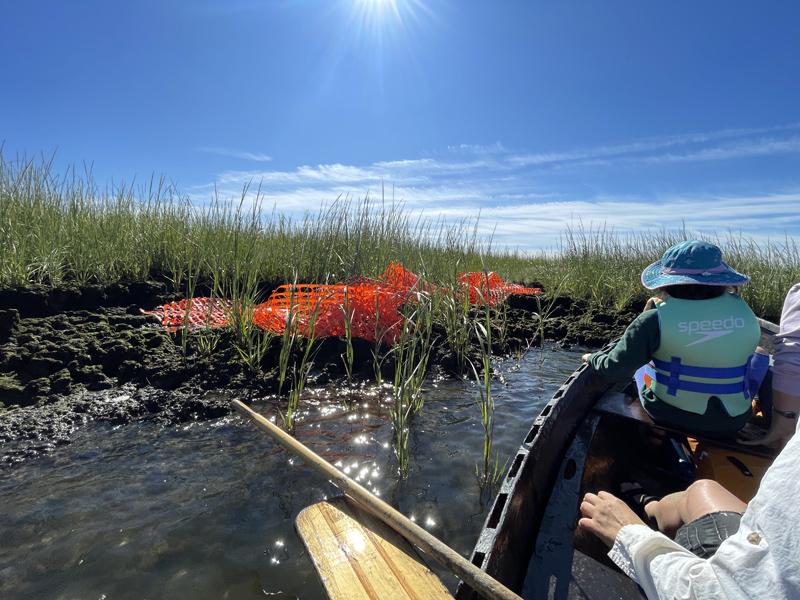
We found some orange net that might make it into the show at MASS MoCA next fall— a peat bog opera!
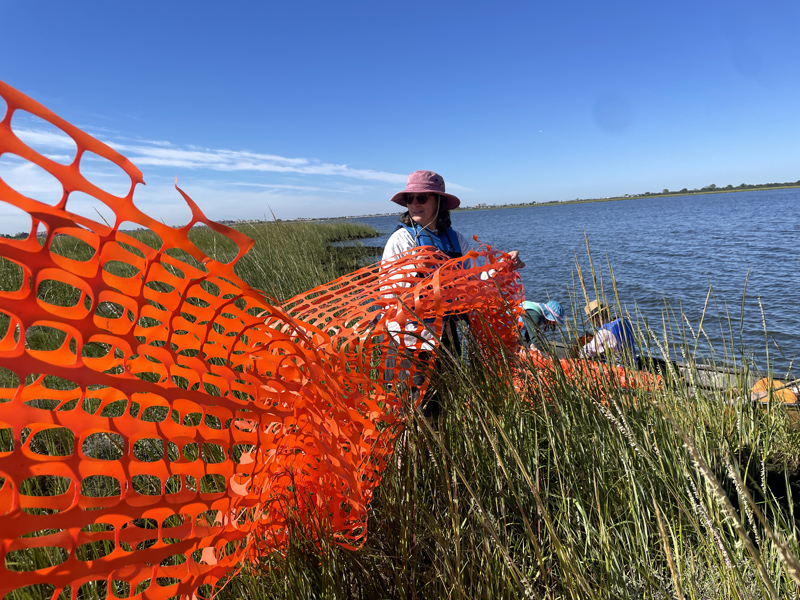
“This net is worth five years of birthday presents,” announced Lou. Such an extreme value, right here, for free, for anyone.
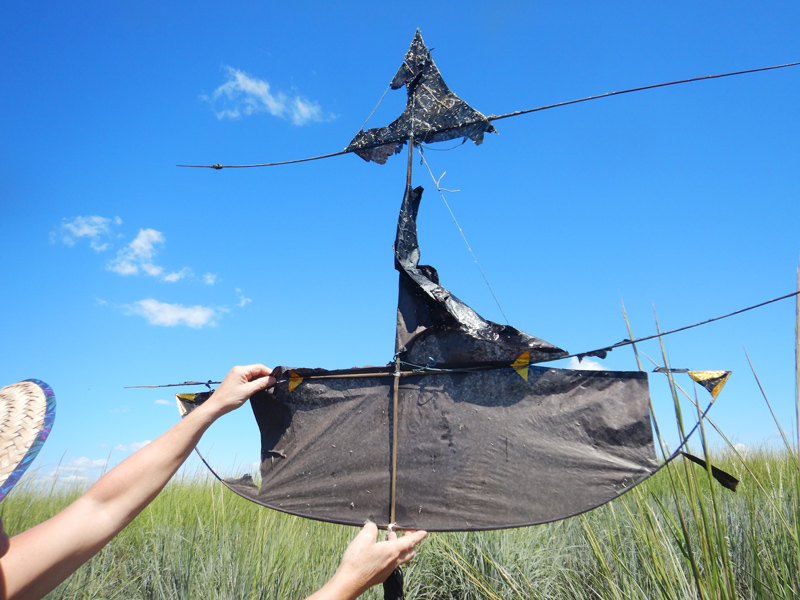
We also found a fighting kite,
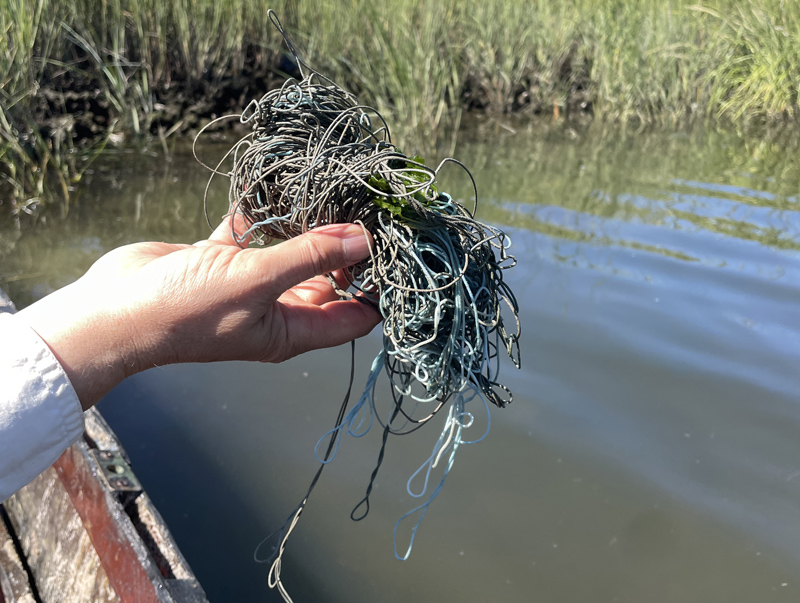
and Lou helped pull hundreds of feet of razor-sharp string out through the cordgrass.
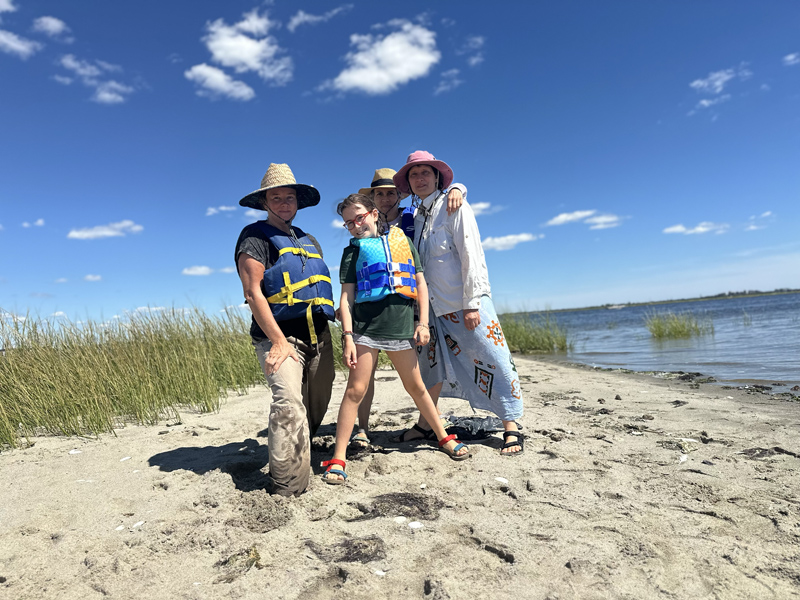
At some point, my camera died, but it was okay.
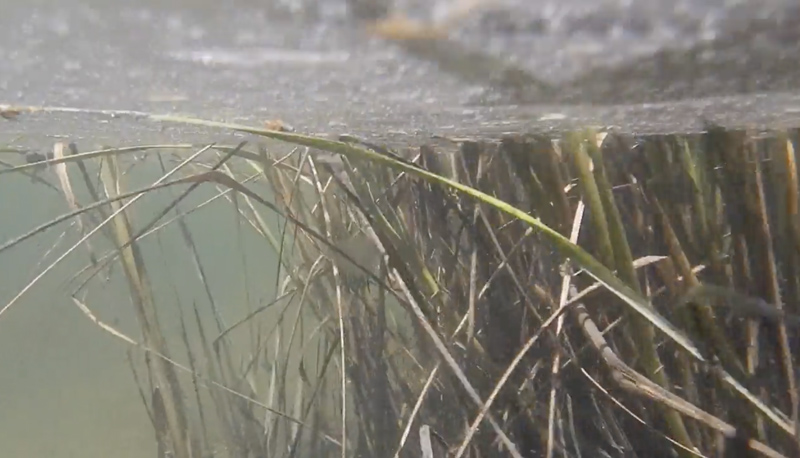
Lou was shooting with Christy’s underwater camera, and that view stands in very well for the rest of the trip.
We were out for almost 8 hours, and it didn’t even seem like enough.
Thank you, Christy, Lou, and Fabienne, for a perfect day in an urban peatland!


Governors Island with Rob Buchanan and Nancy Nowacek

August 29, 2025

On Thursday, Nancy Nowacek and I caught a ride to Governors Island with Rob Buchanan.

Rob has shaped much of the city’s public boating culture; he helped start three community boathouses and is an influential member of the NYC Water Trail Association and the Citizens Water Quality Testing Program.

He had a few things he wanted to check out on our way to Governors Island, like progress on a new kayak launch in Bushwick Inlet Park that will open to the public this year.

We also checked the cages off the Billion Oyster docks.

It seemed like some of the cages were doing well; this is a living oyster.

But some did not look great, filled with empty shells.

Rob showed us where a development is planned for 900 units of luxury condominiums.

Save Bushwick Inlet is a community organization pushing back against the project. They revealed it to be a violation of the rezoning agreement that designated this city-owned land as a “transition zone” meant to connect the neighborhood to the water, not a wall of high-rise towers.

It took seeing this place in person and hearing the backstory from Rob to understand how bad this development would be, how it would turn hard-won public space into the skinny front yard of a massive private luxury development.

“An amenity,” said Rob.

Our next stop was to check on the dock over at the Navy Yard that Rob installed for one of the Village Community Boathouse rowboats.

It was looking pretty good, but we reconnected a missing line.

Then we flew to Governors Island.

“How fast are we going?” I asked, thinking it was 100 mph.

“19 miles per hour,” shouted Rob.

We performed our official mission: to inspect a rowing gig that Rob built with students at the Harbor School.

We still had time for one more stop before our opening.

Over drinks, Nancy and Rob talked about the development at Bush Terminal Park, where there might be an opportunity to keep boats close to the water for public use. They talked about the EDC, the DEC, and the DEP, while I sipped our pitcher of margaritas.

The amount of knowledge that Rob and Nancy share about city organizations and the public waterfront is amazing.

Nancy’s piece in the Works on Water Triennial reminded me how she came to know so much.

From 2012 to 2016, Nancy worked on The Bridge, a public advocacy project and artwork about reclaiming New York City waterways for public use. (This image is by Nancy, from her 2016 iteration of The Bridge.)

While working on The Bridge, Nancy made a myriad of other things: a play, sculptural installations, and this piece, Hydrostatic Lift, composed of every email generated by The Bridge project.

This new sculpture in the Triennial also seems to be about it, or about the interaction of these things—climate change plus all the EDCs and DEPs—how they are nets, each knot dependent and tugging on the next.

We spent some time in one of the cornerstones of the Triennial, Sarah Cameron Sunde’s video installation 36.5 / A Durational Performance with the Sea.

Sarah has performed this piece around the world. Participants stand in one place for a full tidal cycle, submerged and revealed by the sea; their bodies become the measure of rising water’s slow insistence.

The Works on Water 2025 Triennial, curated by Emily Blumenfeld and Kendal Henry, is the latest endeavor by the WoW crew (Nancy and Sarah included) to gather artists working on, in, and with the water.

Here we are with Elizabeth Velasquez, another great artist in the show (her installation is behind us).

The Triennial is up at the Arts Center on Governors Island through October. Come see the show—it is amazing!

Thank you, Rob, Nancy, and Works on Water for netting me into this amazing group.

Coney Island Creek with Sophia Hatzikos and Steve Cameron

August 29, 2025

Steve Cameron, Sophia Hatzikos, and I launched into the Coney Island Creek at a cool little beach at the very end of Bay View Avenue.

We saw the wreck of the yellow submarine,

but most of the “The Ghost Ships of Coney Island Creek” were hidden below the tide.

Steve is studying geography at Hunter, doing his thesis research about urban waterways, climate change, and private property.

I asked him the question that I never ask (because I want it to stay true in my mind), “Is land always public between high and low tide?”

“Not always,” he said.

For instance, it is not public in Massachusetts, where he is from. Private property there extends to the low tide mark, unless in certain situations where you have fishing gear.

In NYC, the intertidal zone is hard to reach, and since most of the shore is a flat wall of cement, it wouldn’t matter anyway.

People seem to find their way there even so,

like these guys we saw fishing with cast nets along the shore of Calvert Vaux Park.

We talked about the latest developments around Governor’s Island, Bush Terminal Park, and places in the New York Harbor with public shorelines.

Sophia is an artist too. She makes beautiful sculpture, video, and installation,

all connected to the elemental movement of water that she researches through swimming and traveling. (This image is from her 2025 Exhibition ‘Zesti’ at Kransberg Arts Foundation, in St. Louis, Missouri.)

Her family is from Greece, and they spend a few months there every year on a sailboat. She just got her captain’s license so she can take care of the boat, and eventually, her family.

She told us about the Greek relationship with the water; how it is not just climate change but economic challenges, questions of sovereignty, and fishing rights that are changing life on the islands.

“Where do you want to end up after school?” Sophia asked Steve. (Maybe because she is also wondering where to end up—and how to get there.)

He said he didn’t know exactly. We talked about how so many cities in the world will change in the next decade, as the waterfront changes. It seems like lots of places will need him.

We landed back on Coney Island so Steve could get to class, his first day back for the fall.

When we were getting out of the boat, Steve accidentally stepped one foot fully in the water.

It seemed like a good way to start school—with one foot wet.

I noticed when I took this picture that Sophia was not wearing shoes at all.

The Dutch Kills with Nate Heiges and Marina Heron Tsaplina

August 29, 2025

The best two people to travel up Newtown Creek, in the south or east direction, are Nate Heiges and Marina Heron Tsaplina.

Nate, because he walks along the edge here every day. His studio and house are at opposite ends of the English Kills.

And Marina, because she used to live in Newtown Creek on a massive houseboat ferry called the Schamonchi.

Marina is an interdisciplinary artist, disability culture activist and writer who works with movement, ecopuppetry, and place-based installation to make a perfect balance of creative vision and activism. This image (by Ken Schles) is from Living Soil Rising, a massive collaborative procession, fossil fuel walking tour, and soils and water ceremony that happened on Newtown Creek earlier this summer. The event was a collaboration between Marina’s artistic project, Soils and Spirit and the No North Brooklyn Pipeline Alliance campaign to retire the largest fossil fuel facility in NYS.  It stands right on the banks of the creek.

It was through Marina that I started to understand the connection between healing the planet and thinking about soil. Simple, I know, maybe everyone else already gets this: earth = earth.

The reflection of the sun on the water was blinding; it was hard to see forward. “Do you see that?” Marina asked.

I strained to see through the light to whatever it was, but then I realized it was the light.

“A portal,” said Marina, a lavender apparition on the water. We spent a minute looking at the light, and then she poured a little water into the creek.

It was an interesting gesture. I wanted to ask why, but didn’t want to interrupt.

When I finally did, the moment had passed.

“It is a ritual… an offering of gratitude to this violated water,” she said. “You must have those, too?”

“I think I just have habits,” I said, completely forgetting about flotsamancy, and how similar it is to our mission for the day.

When we came around the corner and saw the Schamonchi, it took my breath away.

To see it leaning so far to the side was disorienting—the floor as a wall.

It was difficult to fix the massive object in my view, impossible not to feel like it was in motion, which I guess, in some sense, it is.

We floated by slowly, passing a broken open window. “That was my bedroom.”

I was surprised to see it so devoid of stuff, but Marina told us it had been empty for over a year and had only just begun to sink.

“The Newtown Creek is a body,” said Marina,

“drawing us into her vortex… as anyone does when they are traumatized… and trying to heal.”

The sun had set on Dutch Kills, and we paddled back in shadow.

As we rounded the bend at Plank Road,

we caught a few final rays—the ultimate light in darkness.

Here we are at the end of the road, and here is Marina’s drawing of the portal:

Origin Stories with Sasha Cravis and Rachel Yanku

August 25, 2025

Sasha Cravis and Rachel Yanku came out with me on a busy Monday morning.

I hadn’t been out on the creek in almost a year, and was happy to see things chugging along as usual—tons of dirt being ground up, piles of recycling blowing around.

The usual things were comforting after being away from NYC since February.

There were a few new things, like this perfect movie set.

We pondered how it made sense to build a whole new city block instead of just using an existing one, like the very similar blocks where we each live in Brooklyn and Queens.

Sasha had been studying Philippine creation stories recently and told us one:

“Originally, there was just the sea and sky.”

Then a bird, looking for a place to land, stirred up a fight between sea and sky. Land formed to separate them, and as bamboo sprouted from the land, the bird began to peck at the bamboo, releasing two human forms: Malakas (strength) and Maganda (beauty).

“I believe that the two beings didn’t originally have binary genders,” said Sasha, “but culture and christianity’s influence in the 1900s shifted the story to being man and woman.”

Here is an image that I found online, a sculpture of Malakas and Maganda outside of an administration building at the Visayas State University in Baybay, Leyte. A caption under the photo reads: “… a statue symbolizing the pursuit of knowledge and excellence.” Another shift, but maybe better than strength and beauty.

“How is living in New York as a young artist?” I asked.

“Almost impossible,” they agreed.

We looked at the new high-rises. The land here at the mouth of the Newtown Creek used to seem abandoned, underused, but still somehow inaccessible—

“Now it is inaccessible in a different way,” said Rachel.

But here we were, on the other side of the buildings, making it work somehow.

We noticed the extremely high tide in Greenpoint, even covering the ramp at the end of Manhattan Avenue.

“I have never noticed it like that before,” I said, and I wondered if sea level had risen just in the time I was gone.

While technically that must be true, these particular inches have to do with tidal surge from Hurricane Erin, pushing the ocean up into New York City.

Thank you Sasha and Rachel, for the perfect homecoming.

↑ Return to Top of Page ↑